
House of Bid
Spotting quality in antique furniture: joinery and wood
Open a drawer and look closely at the joints, the wood, and the hardware. Hand-cut dovetails, solid wood, irregular saw marks, and hand-forged hardware all point to older or higher-quality work, while perfectly uniform joints and machine hardware suggest later mass production. No single sign proves age or value — they are clues you weigh together.
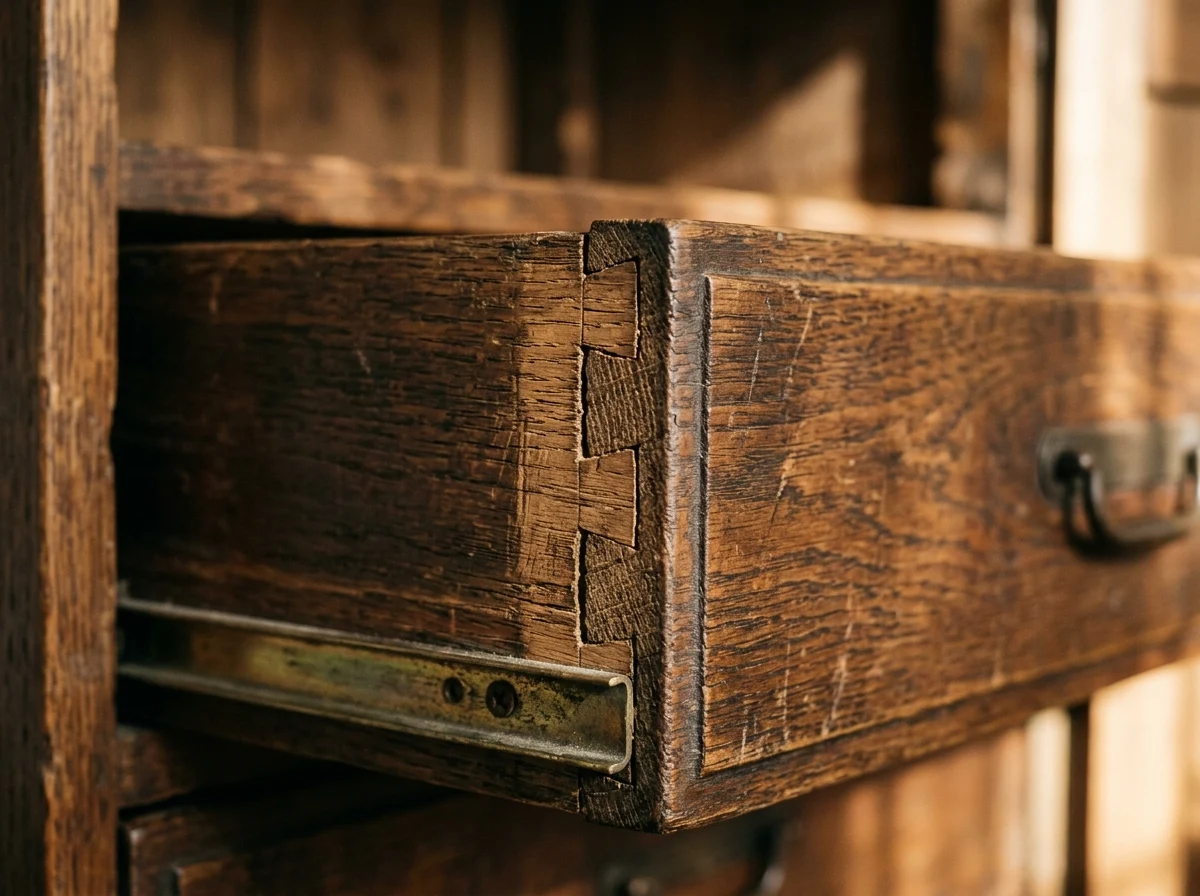
Dovetails: hand-cut vs. machine-cut
Pull out a drawer and look at the joints on the sides. Hand-cut dovetails are irregular — the pins and tails vary slightly in width and spacing because a person cut each one by hand. Machine-cut dovetails, common from the mid-1800s onward, are uniform and evenly spaced, often narrower and more numerous than hand work. Hand-cut joinery generally points to an earlier or more custom piece, but plenty of well-made later furniture also used machine dovetails without being lesser quality.
Solid wood vs. veneer
Veneer isn't automatically a bad sign — high-quality veneer over solid secondary wood has been used in fine furniture for centuries, especially for figured or expensive woods that would be impractical solid. What matters is thickness and application: older veneer tends to be sawn thicker than the thin, machine-sliced veneer used later. Check edges and any chipped spots to see how thick the veneer layer actually is, and look at the wood underneath it for construction quality.
Saw marks, hardware, and other build clues
Look at unfinished surfaces — the underside of a tabletop, the inside of a case — for saw marks. Straight, parallel marks suggest an early pit or up-and-down saw; curved, arced marks suggest a circular saw, which became common later. Screws are another clue: hand-cut screws have irregular, off-center slots and uneven threads, while modern screws are uniform. Original hardware — hinges, pulls, escutcheons — that shows wear consistent with the piece's age is a good sign; obviously new hardware on an old piece raises questions.
Patina and wear tell a story too
Real age leaves wear in logical places: feet, arms, and edges people actually touched, softened over decades rather than sanded flat. Patina — the color and texture a surface develops over time — is hard to fake convincingly, especially in places light wouldn't naturally reach, like drawer interiors or the underside of a top. Uniform, all-over wear or a color that doesn't match between visible and hidden surfaces is worth a second look before you trust the piece's apparent age.
Questions
Are hand-cut dovetails always a sign of an older piece?
- Generally, yes, since hand-cut joinery became less common after machine dovetailing spread in the mid-1800s. But it's one clue among several — check the wood, hardware, and saw marks too before drawing a conclusion.
Does veneer mean a piece is lower quality?
- Not by itself. Fine furniture has used veneer for centuries, often to showcase rare or figured wood that wouldn't be practical solid. Thin, obviously modern veneer over cheap wood is a different situation than thick, well-applied veneer on a solid secondary wood carcass.
What do I actually need to check this myself?
- A flashlight and a willingness to open drawers and look underneath things. Most of these clues — joints, saw marks, hardware wear — are visible without tools, just by looking closely at surfaces the original maker never expected anyone to inspect.